scroll to top
scroll to top
scroll to top
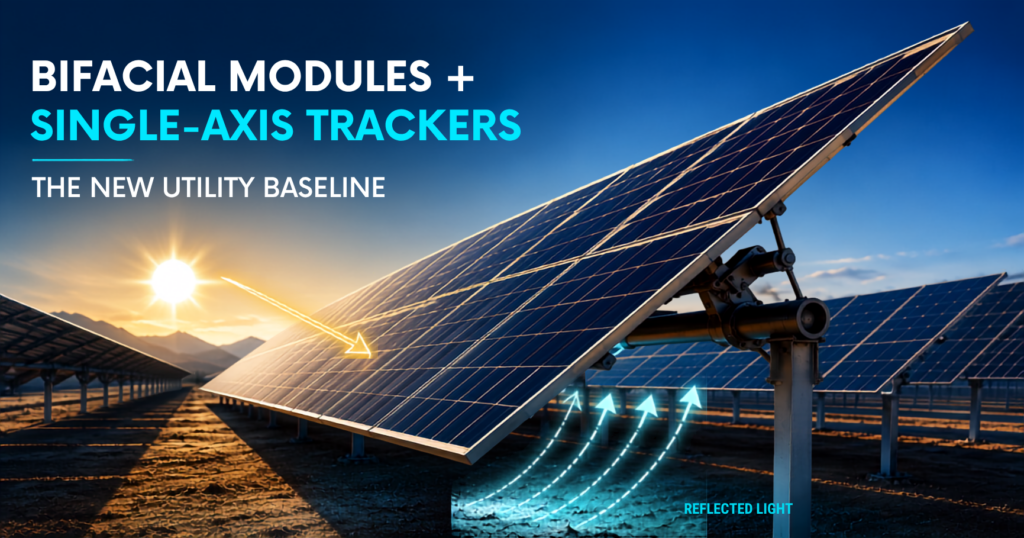
Bifacial solar panels paired with single-axis trackers are becoming an increasingly important configuration for utility-scale solar projects. Together, these technologies can improve energy yield, but the actual gain depends on far more than the module and tracker specifications.
Site conditions, ground reflectivity, bifaciality, tracker geometry, row spacing, shading, backtracking and terrain all influence the amount of energy a solar project can realistically generate.
That raises an important question for developers, EPCs and investors:
Are the energy-gain assumptions behind bifacial solar panels and single-axis trackers realistic enough to support the project’s financial model?
The answer depends on the quality of the engineering model behind those assumptions.
For modern utility-scale solar projects, the objective is no longer simply to select higher-yield technologies. It is to build an energy model based on realistic, measurable and defensible engineering assumptions.
Modern utility-scale solar projects are increasingly adopting n-type technologies such as TOPCon, which offer high efficiency and strong bifacial performance.
Bifacial solar panels can generate electricity from both the front and rear sides of the module. The rear side captures additional irradiance reflected from the ground and surrounding surfaces.
Many current bifacial modules have a bifaciality factor in the range of approximately 75–85%, meaning the rear side can provide a substantial contribution under suitable irradiance conditions.
The potential energy gain can be significant.
Depending on site conditions and system design, bifacial modules can provide approximately 5–15% additional energy compared with comparable monofacial configurations.
However, this should not be treated as a guaranteed project-wide gain.
The rear side of a bifacial solar panel can only generate additional energy when sufficient irradiance reaches it.
And one of the most important factors controlling that irradiance is ground albedo.
Albedo describes the amount of incoming sunlight reflected by a surface.
The ground beneath a solar array therefore plays an important role in bifacial PV performance.
Darker surfaces such as certain soils and vegetation generally have lower reflectivity, while lighter surfaces can reflect significantly more sunlight toward the rear of bifacial solar panels.
Ground albedo can commonly fall around 0.2–0.3 for many typical surfaces, while brighter surfaces can have considerably higher values.
This difference can materially affect the modeled bifacial energy gain.
If a solar model assumes an aggressive albedo value that the project site cannot realistically maintain, the projected energy gain may be overstated.
This becomes particularly important when energy production estimates are used to determine:
An optimistic albedo assumption is therefore not simply an engineering concern.
It can become a financial and bankability concern.
Alongside bifacial solar panels, single-axis solar trackers have become a common configuration for utility-scale PV projects.
Trackers allow solar modules to follow the sun throughout the day, increasing the amount of solar irradiance captured by the array.
Compared with conventional fixed-tilt systems, single-axis tracking can often provide approximately 15–25% higher annual energy yield, depending on factors such as location, tracker configuration and system losses.
But maximizing theoretical tracking performance does not necessarily mean maximizing real-world production.
A tracker design must account for multiple site and system conditions, including:
A tracker model that performs well under idealized conditions can produce significantly different results when actual site constraints are introduced.
This is why single-axis tracker design needs to be evaluated together with site geometry and solar array configuration.
The biggest modeling risk is not necessarily one aggressive assumption.
It is the combination of several assumptions.
Consider a utility-scale solar project that assumes:
High bifaciality + favorable albedo + optimized tracker operation + limited backtracking losses + low shading losses
Individually, each assumption may appear reasonable.
But when they are combined, they can create a materially optimistic production forecast.
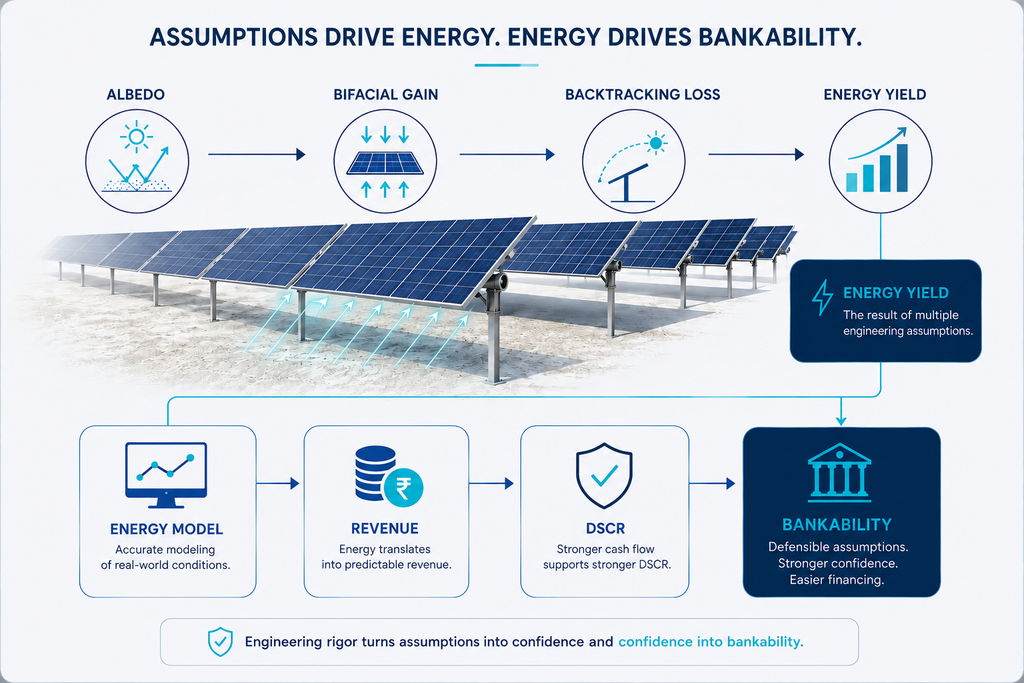
This is where engineering rigor becomes critical.
The right question is not:
“What is the maximum energy this system could produce?”
Instead, a bankable solar design should ask:
“What energy yield can this project reasonably defend?”
That distinction is critical when projected energy production is ultimately connected to the project’s financial model.
For utility-scale solar projects, projected energy production is closely connected to project economics.
A simplified relationship looks like this:
Energy Yield → Revenue → Cash Flow → DSCR → Debt Capacity
Even a relatively small change in annual generation can influence the financial assumptions supporting a project.
That is why lenders, investors and technical advisors increasingly look beyond the headline annual MWh figure.
They also examine the assumptions used to arrive at that figure.
For projects using bifacial solar panels and single-axis trackers, important considerations include:
The objective isn’t to make the energy model unnecessarily conservative.
The objective is to make it defensible.
The strongest utility-scale solar designs don’t simply chase the highest theoretical energy gain.
They establish a transparent connection between:
Site Conditions → Engineering Assumptions → System Design → Energy Yield → Financial Model
That means validating the physical conditions behind the model before those assumptions become part of the project’s financial projections.
For bifacial solar panels combined with single-axis trackers, this can include:
The goal is not simply to produce a higher number.
It is to produce a number that can withstand technical and financial scrutiny.
As bifacial solar panels and single-axis trackers become increasingly common in utility-scale PV projects, the competitive advantage is shifting.
It is no longer simply about specifying the latest high-performance technology.
It is about engineering the entire system around realistic and defensible assumptions.
A project may have high-efficiency modules and advanced tracking technology, but the resulting energy yield still depends on how accurately those technologies are modeled against actual site conditions.
For developers, EPCs and investors, that distinction matters.
Bankability isn’t about having the biggest number.
It’s about having a number you can defend.
Bifacial solar panels and single-axis trackers can provide meaningful energy-yield improvements for utility-scale solar projects. But those gains are highly dependent on the conditions in which the system is designed and modeled.
Albedo, rear-side irradiance, bifaciality, tracker geometry, shading, backtracking, terrain and other site-specific factors can all influence actual production.
As a result, the quality of the engineering assumptions behind the energy model is just as important as the technology being specified.
A well-engineered solar project connects real site conditions with realistic energy-yield expectations, creating a stronger foundation for technical evaluation, financial modeling and project decision-making.
DIN’s engineering approach focuses on this gap—connecting detailed solar design and analysis with the assumptions that ultimately support project decisions.
Planning your next utility-scale solar project?
Connect with DIN’s engineering team:
📧 sales@dinllp.com
What are bifacial solar panels?
Bifacial solar panels can generate electricity from both the front and rear sides of the module. The rear side captures additional irradiance reflected from the ground and surrounding surfaces.
How much additional energy can bifacial solar panels generate?
The original analysis indicates that bifacial modules can provide approximately 5–15% additional energy compared with comparable monofacial configurations, depending on site conditions and system design. Actual gains vary by project.
What is albedo in a solar PV project?
Albedo refers to the amount of incoming sunlight reflected by a surface. In bifacial solar projects, ground reflectivity can influence the amount of irradiance reaching the rear side of the modules.
What are single-axis solar trackers?
Single-axis trackers are mounting systems that rotate solar modules along one axis to follow the sun throughout the day. They can increase annual energy yield compared with fixed-tilt systems, depending on location and system design.
What affects bifacial solar panel performance?
Important factors include ground albedo, rear-side irradiance, bifaciality, row spacing, module height, shading, tracker geometry, terrain and site conditions.
Why are energy-yield assumptions important for solar project bankability?
Projected energy production affects revenue and cash-flow expectations, which can influence metrics such as DSCR, debt capacity and investment decisions. This makes the assumptions behind energy-yield models important to project bankability.

Find out how leading companies use DIN to stay ahead of the competition and reduce critical costs. Get in Touch