scroll to top
scroll to top
scroll to top
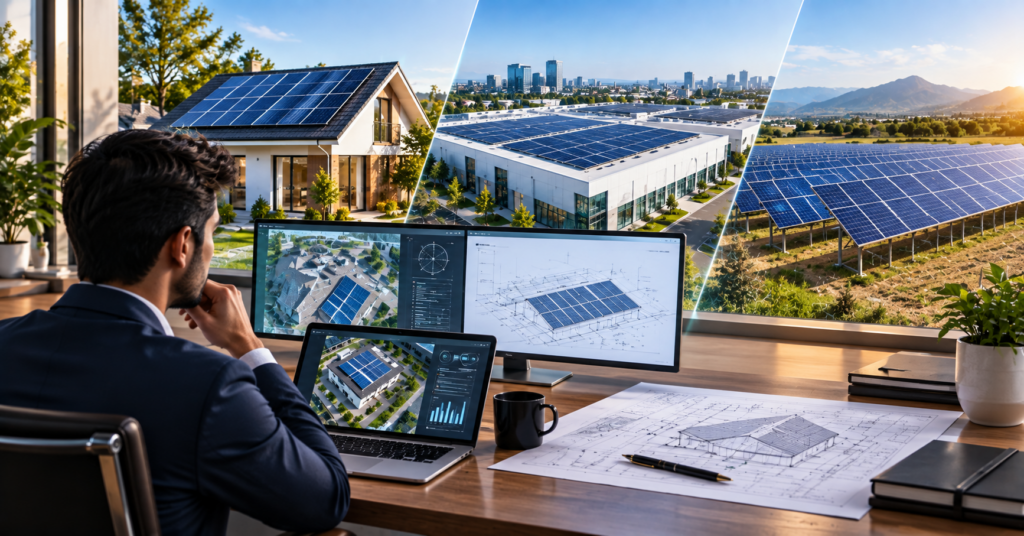
Investing in solar energy is a smart move—but the success of your system depends heavily on one crucial factor: solar installation design. A well-planned design ensures maximum energy production, regulatory compliance, and long-term cost savings, while a poorly designed system can lead to inefficiencies, delays, and unexpected expenses.
Whether you’re a homeowner, business owner, or solar developer, choosing the right solar installation design for your property is essential. Here’s how to make the right decision.
Solar installation design is the technical planning process that defines how a solar PV system will be configured, installed, and integrated with your property. It goes far beyond placing panels on a roof or ground.
A complete solar installation design typically includes:
This design phase lays the foundation for system performance, safety, and approval.
Every property is unique, and your solar installation design should reflect that.
Residential Properties
Designs must account for:
Commercial & Industrial Properties
Commercial projects require more complex PV design, including:
Ground-Mounted Systems
For open land or utility-scale projects, solar installation design must consider:
Choosing the wrong design approach for your property type can significantly reduce efficiency and delay approvals.
High-quality PV design directly impacts how much energy your system produces over its lifetime. Professional PV design focuses on:
Advanced PV design tools simulate real-world conditions, helping designers predict performance accurately and optimize the system before installation even begins.
Even the best solar installation design won’t move forward without proper approvals. This is where solar permitting becomes critical.
Permitting requirements vary by:
Designs must be code-compliant from the start to avoid costly revisions and resubmissions.
Navigating permit applications can be time-consuming and complex. Professional solar permit services streamline this process by ensuring:
When solar installation design and solar permit services are handled together, projects move faster and more smoothly from concept to commissioning.
Before finalizing your design, consider these critical factors:
1. Energy Goals
Are you aiming for partial offset, net-zero, or future expansion? Your solar installation design should align with long-term energy plans.
2. Budget and ROI
A cost-effective design balances upfront investment with long-term performance and maintenance savings.
3. Local Regulations
Designs must meet local building codes, interconnection rules, and solar permitting requirements from day one.
4. Future Scalability
Good PV design allows room for future system expansion, battery storage, or EV charging integration.
While online tools offer quick estimates, they often lack:
Professional solar installation design services combine engineering expertise with real-world experience, resulting in systems that perform better, last longer, and pass inspections without delays.
Choosing the right solar installation design is not just a technical decision – it’s a strategic one. A professionally engineered design that integrates smart PV design and efficient solar permitting can dramatically improve system performance, reduce approval timelines, and maximize your return on investment.
Whether you’re planning a small residential system or a large commercial project, investing in expert design and solar permit services ensures your solar journey starts on solid ground.
A successful solar project starts with the right design – and the right partner. At DIN Engineering & Consulting LLP, we provide end-to-end solar installation design services that combine precision PV design with seamless solar permitting support.
Our team helps homeowners, EPCs, and developers:
Design smarter. Get approved faster. Build with confidence.
Visit us to explore our solar installation design and solar permit services – or contact our experts to get started today.

Find out how leading companies use DIN to stay ahead of the competition and reduce critical costs. Get in Touch