scroll to top
scroll to top
scroll to top

Hybrid fiber-wireless design is an approach to telecom network planning that coordinates fiber-optic infrastructure with wireless technologies such as 5G small cells, Distributed Antenna Systems (DAS), private wireless networks, IoT connectivity, and future 6G infrastructure.
Instead of designing fiber and wireless networks as separate systems, a hybrid approach considers how fiber routes, wireless access points, equipment locations, power, pathways, permitting, and future expansion requirements work together.
This approach is becoming increasingly important as telecom networks become denser and more distributed.
The future of telecom infrastructure is becoming increasingly hybrid. Fiber networks remain the foundation for high-capacity connectivity, while the rapid expansion of 5G, emerging 6G technologies, private wireless networks, IoT, and edge computing is changing how telecom infrastructure is planned and deployed.
Modern hybrid fiber-wireless design brings these technologies together, enabling fiber networks to support dense wireless infrastructure such as 5G small cells, Distributed Antenna Systems (DAS), edge locations, and other radio access network components.
As telecom networks become more distributed and connected, network planners and engineering teams need to design infrastructure that supports today’s connectivity requirements while allowing room for future expansion.
This is where fiber and wireless network design converge – creating a telecom infrastructure backbone capable of supporting FTTx, 5G, IoT, enterprise connectivity, and the evolving requirements of 6G.
FTTx-whether FTTH, FTTB, FTTC, or other architectures-has traditionally focused on bringing fiber closer to the end user.
That role isn’t disappearing. In fact, growing bandwidth demand makes fiber more important than ever.
But the same fiber infrastructure is increasingly being used to support wireless networks.
5G networks require extensive fiber connectivity between radio equipment, aggregation points, edge computing locations, and the broader core network. Small cells deployed across urban areas also require reliable backhaul and, in many cases, fronthaul connectivity.
This creates a convergence between traditionally separate infrastructure layers.
A single fiber route may need to support:
This means network planners can no longer look at fiber routes in isolation.
They need to consider where wireless infrastructure will be deployed today-and where it may need to expand tomorrow.
One of the defining characteristics of advanced wireless networks is network densification.
Instead of relying exclusively on large macro cell sites, operators can deploy smaller radio nodes closer to users. These small cells help improve capacity and coverage in areas where traditional macro infrastructure may not be sufficient.
Urban environments are particularly suited to this approach.
Small cells can be integrated into:
But every additional wireless node introduces additional infrastructure requirements.
Power must be considered.
Fiber connectivity must be considered.
Equipment placement, pathway availability, structural constraints, permitting, and maintenance access must also be considered.
This creates a design challenge:
The wireless network may be invisible to the end user, but the physical infrastructure supporting it is not.
A poorly coordinated fiber route can create unnecessary construction, congestion, or future expansion limitations.
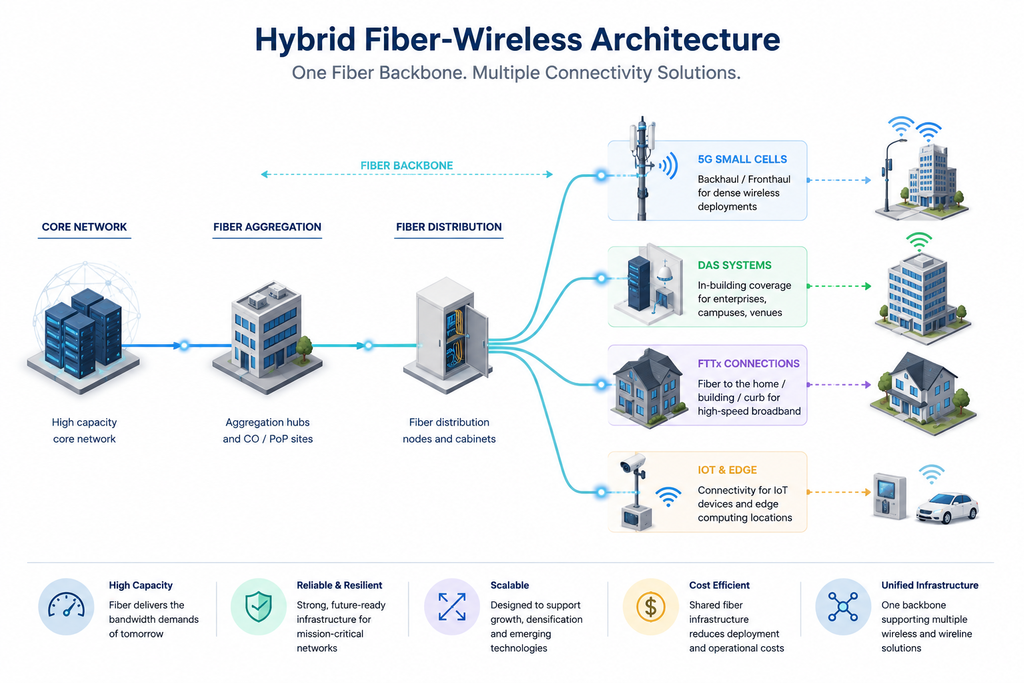
A hybrid approach allows network designers to coordinate fiber and wireless infrastructure as parts of the same system.
At a high level, the architecture may look like:
Core Network → Fiber Aggregation → Fiber Distribution → Wireless/FTTx Access Points → End Users & Devices
Depending on the network, fiber may terminate at a premise, connect to a small-cell location, feed a DAS head-end, or provide connectivity to an edge facility.
The important change is not simply where the fiber terminates.
It is how the entire network is planned around multiple service requirements.
For example, a fiber route serving a commercial district could potentially accommodate traditional enterprise connections while also providing connectivity for nearby small cells.
That requires greater coordination during the planning and design stages.
While 5G deployment continues to evolve, the industry is already researching and developing technologies associated with 6G.
The exact architecture of future 6G networks will continue to develop, but one principle is increasingly clear:
Future wireless networks will require extensive underlying infrastructure.
Higher frequencies, greater capacity, ultra-low latency applications, AI-enabled networks, sensing applications, and massive device connectivity could all contribute to greater network densification.
That means the physical infrastructure designed today needs to account for tomorrow’s requirements.
Fiber offers a critical advantage because of its enormous capacity and ability to support high-speed, low-latency communications.
But simply installing more fiber isn’t enough.
The network must also be:
Scalable.
Accessible.
Coordinated.
Documented.
Ready for expansion.
The convergence of fiber and wireless infrastructure introduces a new layer of complexity for telecom engineering and drafting teams.
Traditional fiber design may focus heavily on routes, splice points, cabinets, distribution architecture, and customer connections.
Wireless infrastructure introduces additional considerations.
Design teams may need to coordinate:
The challenge is creating documentation that represents the entire physical network, rather than treating each infrastructure component as an isolated project.
As networks become denser, accurate documentation becomes increasingly valuable.
A telecom project may involve large quantities of field data, GIS information, aerial imagery, existing utility records, engineering drawings, and equipment information.
Turning this information into coordinated design documentation requires consistency.
CAD drawings can communicate detailed infrastructure layouts.
GIS can provide spatial context.
Field data can validate existing conditions.
Together, these tools can create a more complete picture of the network.
For large-scale deployments, standardized drafting workflows can also help maintain consistency across multiple sites, markets, and design teams.
One of the biggest considerations for hybrid networks is future capacity.
A network designed only for today’s requirements can become difficult to expand as demand increases.
For example, a conduit pathway that has no spare capacity may require additional civil work when new small cells or fiber customers are added.
Similarly, an infrastructure layout that doesn’t account for equipment access or future fiber distribution can increase the complexity and cost of later upgrades.
This is why modern telecom design increasingly needs to consider:
“What will this network need next?”
rather than only:
“What does this network need today?”
Designing with expansion in mind can help reduce unnecessary rework and support more efficient future deployments.
Distributed Antenna Systems (DAS) are another important component of this evolving infrastructure.
In locations where traditional cellular coverage is difficult-such as large buildings, transportation hubs, campuses, stadiums, and other high-density environments-DAS can distribute wireless signals throughout a defined area.
A DAS deployment may require coordination between:
Fiber → Head-End → Remote Units → Antenna Distribution
This makes DAS another example of why fiber and wireless design can no longer be viewed independently.
The physical network connecting wireless equipment becomes just as important as the radio technology itself.
As 5G networks mature and 6G development progresses, telecom infrastructure is likely to become more distributed.
For engineering and drafting teams, this means the traditional boundaries between fiber design, wireless design, and telecom infrastructure documentation will continue to blur.
The successful network won’t simply be the one with the most fiber or the most wireless nodes.
It will be the one where those components are designed to work together.
The telecom industry is moving toward an infrastructure model where fiber provides the high-capacity foundation while wireless networks extend connectivity closer to people, machines, and devices.
That makes hybrid fibre-wireless planning increasingly important.
For telecom A&E teams, the opportunity lies in creating design workflows that can accommodate both current deployment requirements and future network evolution-from FTTx and 5G small cells to DAS, IoT, and eventually 6G infrastructure.
Because the next generation of connectivity won’t be built with fiber alone.
And it won’t be built with wireless alone.
It will be built where the two converge.
Fiber isn’t just fibre anymore.
It is the backbone connecting the increasingly dense wireless world around it.
Planning your next telecom infrastructure project? Connect with DIN at sales@dinllp.com to discuss your A&E and telecom drafting requirements.

Find out how leading companies use DIN to stay ahead of the competition and reduce critical costs. Get in Touch