scroll to top
Artificial intelligence (AI) is transforming the solar energy industry. From automated rooftop analysis to site assessment and photovoltaic (PV) layout planning, AI-powered tools are creating new opportunities to improve the efficiency of solar design workflows.
However, behind every AI model that recognizes a rooftop, identifies solar panels, or detects potential obstructions is an essential component: high-quality solar data annotation.
AI models need accurately labeled images and technical datasets to learn how to identify and interpret real-world features. Without reliable training data, even sophisticated computer vision systems can struggle to distinguish roof planes from shadows, identify rooftop equipment, or recognize existing solar installations.
This is where solar data annotation connects solar engineering expertise with artificial intelligence.
In this article, we explore what solar data annotation is, how it supports AI-driven solar design, and why technical domain knowledge matters when preparing training datasets for solar applications.
Solar data annotation is the process of labeling and organizing solar-related images, drawings, and other datasets so that machine learning models can recognize specific objects, features, and patterns.
These datasets may include:
Depending on the intended application, annotation may involve drawing bounding boxes around objects, outlining roof surfaces with polygons, segmenting images into meaningful regions, classifying components, or labeling features in technical drawings.
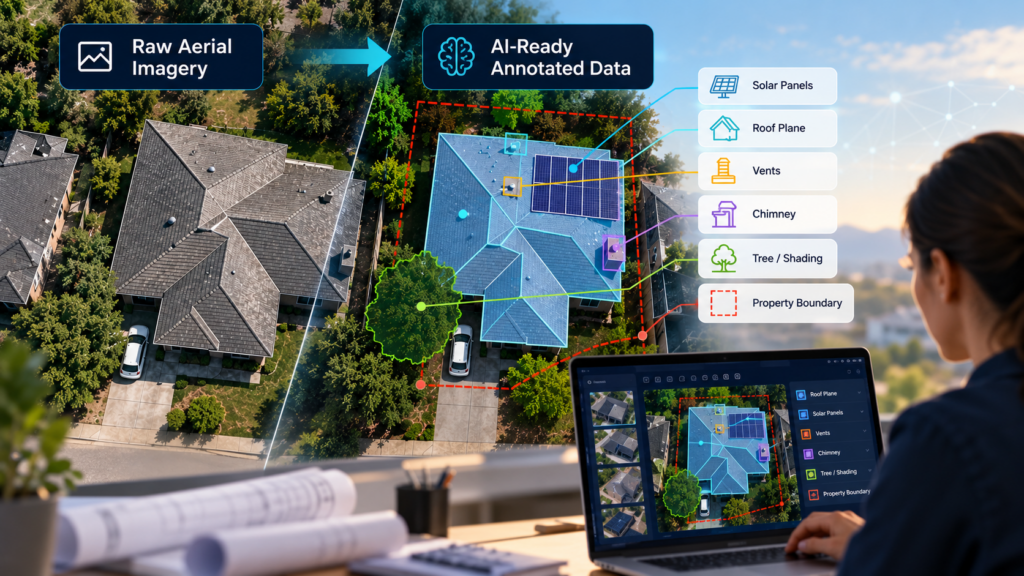
For example, an annotated rooftop image may identify roof planes, solar panels, vents, chimneys, trees, shading areas, and property boundaries.
These labels help AI models learn from examples and recognize similar features in new images.
A solar designer can often interpret a rooftop image by considering its geometry, surrounding structures, and potential installation constraints. An AI model, however, must learn to recognize these features from data.
Solar AI training data provides the labeled examples that help computer vision models learn what they are looking at.
Consider an AI application designed to identify rooftops that may be suitable for solar installations.
The training process could involve thousands of annotated images in which:
The model can use these examples to learn visual patterns and apply them to new imagery.
The accuracy of the resulting predictions depends on several factors, including image quality, dataset coverage, annotation consistency, model design, and validation.
Solar image annotation can support several types of computer vision tasks. The specific features selected depend on the application being developed.
1. Roof Planes and Roof Boundaries
Annotators identify and outline individual roof sections to help AI models understand rooftop geometry.
This information can support automated roof analysis and serve as an input to workflows that estimate potentially usable roof areas.
2. Existing Solar Panels
Solar panels can be identified and labeled in aerial imagery or rooftop photographs.
These annotations may support applications such as existing solar installation detection, property-level solar analysis, and solar asset mapping.
3. Rooftop Obstructions
Vents, chimneys, skylights, HVAC units, and other rooftop structures may affect how a solar installation is planned.
Annotating these features can help train AI models to recognize potential design constraints during preliminary rooftop assessment.
4. Trees and Potential Shading Areas
Trees and nearby structures can influence sunlight exposure and solar access.
Image annotation can identify vegetation and other visible features that may contribute to shading analysis. However, image labels alone do not establish actual shade duration or energy losses; those assessments may require additional spatial, temporal, and solar-irradiance data.
5. Property Boundaries and Surrounding Structures
Property boundaries, neighboring buildings, driveways, and detached structures may also be annotated when relevant to the AI application.
These labels can help models distinguish the target property from its surroundings.
An aerial image initially contains visual information, but it does not automatically provide the structured labels an AI model needs.
A systematic annotation workflow transforms that image into a labeled dataset.
Typical workflow:
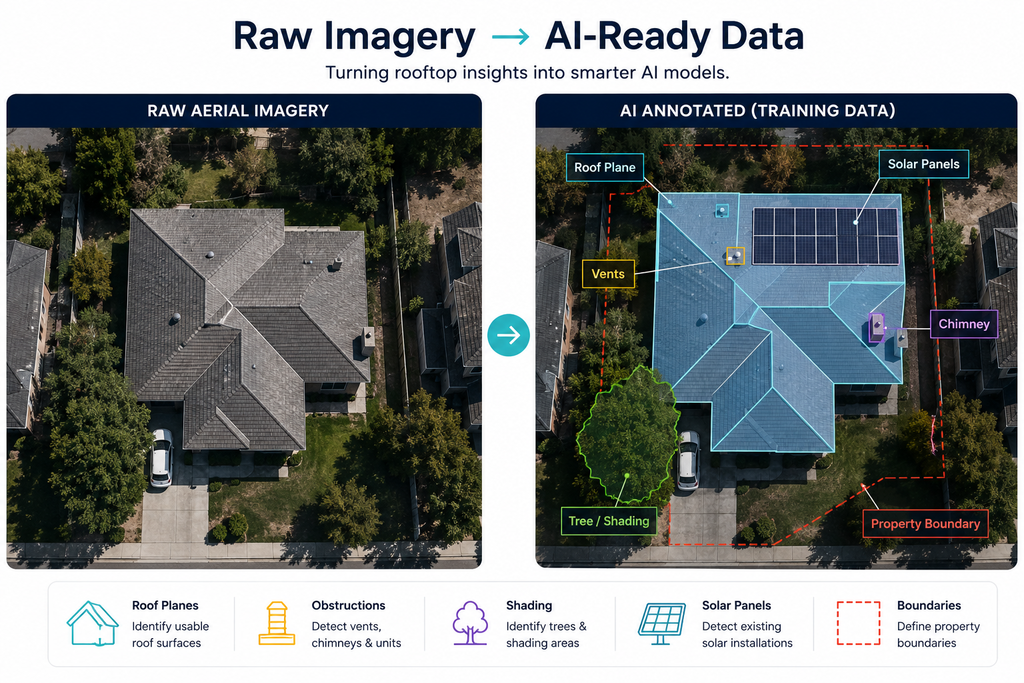
Suggested image alt text: Solar data annotation showing raw aerial rooftop imagery transformed into AI-ready training data.
The visual comparison demonstrates how an unmarked rooftop image can become a structured dataset with labeled roof planes, solar panels, vents, chimneys, tree shading, and property boundaries.
Data annotation requires more than identifying visible objects. In specialized industries, understanding the context behind those objects can be equally important.
Consider a rooftop containing solar panels, an HVAC unit, several roof planes, and nearby trees.
A general-purpose annotation workflow may identify the visible objects. A workflow informed by solar engineering requirements can also apply clearly defined labeling rules that reflect the intended use of the dataset.
For example, the annotation guidelines may specify how to distinguish:
These distinctions matter because inconsistent labels can introduce noise into training data.
Combining annotation skills with domain-specific guidance, standardized labeling rules, and quality checks can help produce datasets that are more consistent and useful for specialized AI applications.
Accurately annotated datasets can support the development of AI tools for several solar industry applications.
Automated Rooftop Analysis
Computer vision models can be trained to identify roof boundaries, roof planes, and visible obstructions in aerial imagery.
Solar Potential Assessment
Annotated images can help train models to identify roof characteristics and other visible features relevant to preliminary solar suitability assessments. Detailed feasibility analysis still requires appropriate engineering, shading, structural, and electrical information.
AI-Assisted PV Layout Planning
Models trained on rooftop geometry and obstruction data may help automate parts of the preliminary panel-placement process.
Engineering review remains important to verify layout constraints, applicable codes, equipment requirements, and project-specific conditions.
Existing Solar Installation Detection
Annotated aerial imagery can support models that identify existing PV systems across residential, commercial, and industrial properties.
Geospatial Solar Analysis
Labeled imagery can contribute to larger geospatial workflows that analyze buildings, land features, and existing solar infrastructure across defined geographic areas.
These applications demonstrate how solar data annotation can support AI development, rather than replace the engineering expertise required to validate solar projects.
A large dataset is not necessarily a high-quality dataset.
Incorrect object labels, missing features, inconsistent boundaries, and ambiguous annotation rules can affect the usefulness of training data.
A reliable solar annotation workflow should therefore include:
For example, if one annotator labels a rooftop shadow as part of a roof surface while another classifies it separately, the resulting dataset may contain inconsistent examples.
Standardized guidelines and systematic reviews help reduce these inconsistencies.
The goal is not simply to annotate more images. It is to create accurate, consistent, application-ready training data.
As AI adoption expands across the solar and built-environment sectors, companies with relevant technical knowledge may have opportunities to contribute to the AI training data ecosystem.
Solar engineering professionals already work with rooftop imagery, site plans, CAD drawings, equipment layouts, and technical documentation.
This experience can be relevant to preparing specialized datasets for computer vision and machine learning.
The opportunity lies at the intersection of three disciplines:
For engineering service providers, this represents a potential extension of existing technical capabilities into a developing market.
DIN Engineering Services works across technical service areas that include solar design, CAD-related work, roofing measurements, and engineering documentation.
These areas involve interpreting visual and technical information about rooftops, structures, site features, and equipment.
That knowledge creates a relevant foundation for exploring specialized data annotation opportunities, particularly where solar or built-environment context is important.
Potential areas to explore include:
Each application requires its own scope, annotation guidelines, quality criteria, and validation process.
By combining technical interpretation with structured annotation workflows, DIN can explore how its existing engineering knowledge may contribute to AI training data for solar and related industries.
AI is creating new possibilities for analyzing rooftops, identifying solar installations, interpreting site imagery, and supporting preliminary design workflows.
But these capabilities depend on the quality of the information used to train the models.
Solar data annotation helps bridge the gap between raw visual information and structured training datasets. When supported by consistent guidelines, quality assurance, and relevant domain expertise, it can help create more reliable foundations for specialized AI applications.
For the solar industry, the opportunity is clear: engineering knowledge can contribute not only to designing solar installations but also to helping AI systems learn to interpret the environments in which those installations operate.
Better annotations. Better training data. More informed AI development.
Are you developing computer vision solutions for solar, roofing, AEC, or geospatial applications? DIN is interested in exploring how engineering domain knowledge and structured data workflows can support specialized AI training data requirements.
Contact DIN Engineering Services to discuss your requirements.
Email: sales@dinllp.com
Website: https://dinllp.com/data-annotation/

Find out how leading companies use DIN to stay ahead of the competition and reduce critical costs. Get in Touch